How Weight Loss Apps Can Charge $2,500 Upfront

Most weight loss app companies run countless pricing tests.
These tests lead them to conclude "we couldn't charge more than $100/mo for a weight loss plan without conversion rates plummeting and churn increasing significantly."
Are they right?
Yes, if all they did was increase price.
No, if they also sell and deliver the plan differently.
Here's what I mean.
Selling it differently:
Quiz funnels and checkout pages are amazing for selling $5 to $100 products.
The price is low enough where it essentially becomes an impulse purchase that they feel comfortable making on a whim.
However, they're horrible for selling $1,000 to $5,000 products.
Why? Imagine the following scenario.
You're at the gym and mention to a personal trainer that your back has been killing you lately.
He says "I actually have a 12 week plan that fixes back pain. It's $2,500. It really works and you're gonna love it."
You say "No, I'm good thanks" and think to yourself "That's way too expensive. I'll just buy a $20 foam roller and that might fix it."
The trainer says nothing, and walks away.
What just happened there?
People buy products when they believe the value it provides exceeds the price.
You didn't see the value and therefore decided not to buy.
It's very difficult for the man to communicate the true value of the product when he doesn't know anything about you and is forced to make a one size fits all offer.
This is exactly how a checkout page works.
So how should the man have sold the product to you?
By first asking questions to uncover the true value of fixing your back pain.
- "How long have you been dealing with back pain?"
- "What have you tried to solve this?"
- "Why hasn't that worked?"
- "What happens if you don't finally solve this?"
- "Why is it so important for you to solve this?"
By answering these questions, the man may help you realise that your back pain is ruining your mood almost every day and preventing you from playing with your kids.
Now, that's a very painful problem that you feel very compelled to solve.
Then he could go on to explain how his 12 week plan solves the exact problem you're facing and alleviates these pains. You believe the value exceeds the price, and so you buy.
This is how 1-on-1 selling works.
It's how we've upsold $325M worth of $1,000 to $18,000 coaching plans.
Delivering it differently:
Most overweight people fail at losing weight.
Why?
It's not because they don't know what to do. Most people have consumed an abundance of free material explaining the law of thermodynamics and how to achieve a calorie deficit.
The real issue is that people just don't do the work.
And here's the key part: They know it. Which means the thing they need and value the most in a plan is accountability.
Most weight loss apps have features that provide accountability. This typically includes automated checkins, an AI coach, gamification, and more.
Users find these features valuable.
But there's another feature that they find significantly more valuable:
An expert fitness coach that hand-holds them through their entire weight loss journey. Not an LLM wrapper labelled as an AI coach, instead a real human.
Your app can hand them the perfect plan and give them guidance. But it won't be the person they fear letting down when they're craving donuts at 10pm.
They're willing to pay significantly more for this. Because they understand it's more effective and also perceive a human's time as more valuable than an app.
So what do these changes look like in practice?
We use a post-purchase redirect, in-app popups, emails, and SMS to redirect users to a funnel offering a free consultation call; of which around 30% of people book.
The best performing offers we've found are "Book your free metabolic assessment call" and more recently "We have a free gift. Book your call to claim it."
We then have a 10-300 person sales team that delivers the free offer, follows the question/discovery based sales process explained earlier, pitches the appropriate plan, and closes the deal.
We consistently average a 27% call conversation rate and $2,500 AOV across our teams.
The sales person then hands off the customer to the delivery team who onboard them, assign them their personal coach, and guide them to hitting their weight loss goal.
Who is this $2,500 coaching plan for?
You may be thinking "Most of our users earn a median salary and struggle to pay their rent. $2,500 is a lot of money for them. I'm not sure they can afford it."
Here's the key thing to understand:
Most of your users are 5-20 lbs overweight and just want to get a bit slimmer. They aren't in much pain and don't have much urgency.
Some of your users are 30-150 lbs overweight. They are in massive pain and have massive urgency.
Most of the former segment won't pay this amount. However the latter segment absolutely will. Often through a buy now pay later service like Klarna.
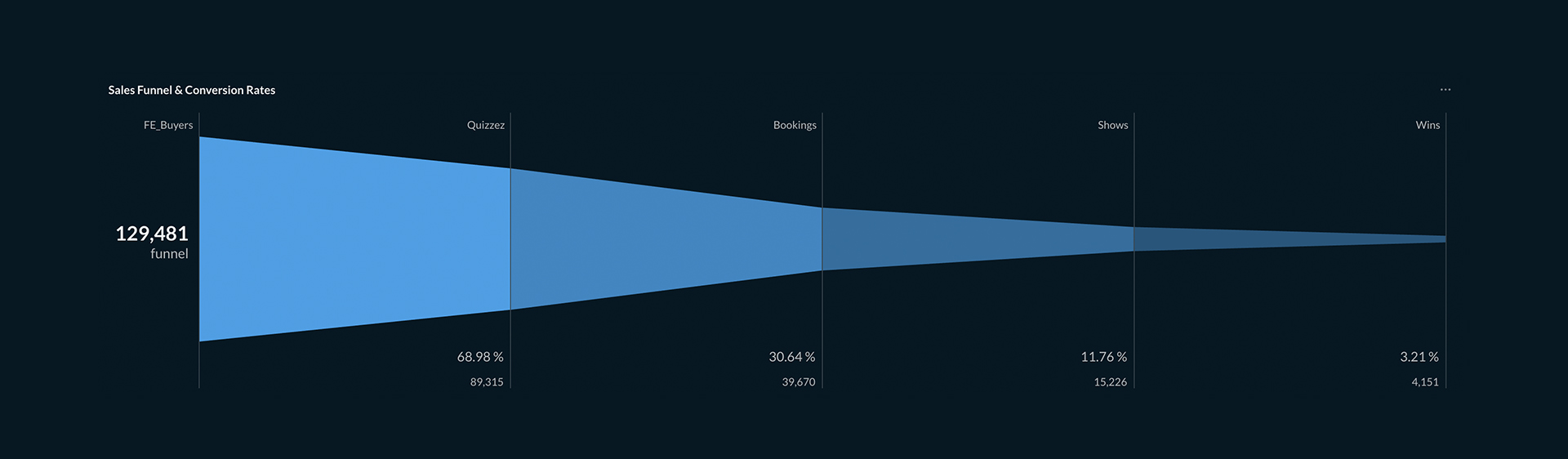
So this isn't for all your users. And that's fine, because when you get 3% of your users to pay $2,500 on day 1, you still make a lot more money.
Real life example of 3.21% upsell rate at scale:
Payback math:
The latter segment is currently choosing your $50 to $100 premium subscription, paying a few hundred dollars over their lifetime.
With this new model they'll instead pay you $2,500 upfront, on day 1.
In other words, they pay you more, faster, with zero churn risk.
This means you can afford a higher CAC, outbid your customers in ad auctions, and profitably scale ad spend without cashflow constraints.
How does this fit into your current product suite?
You've spent years optimising your existing premium upsell. The last thing we're suggesting is to immediately replace it with this new upsell.
Instead, we typically do the following.
We start by promoting the free consultation call funnel to just 500 users. Just enough to let the data regress to the mean and be fully accurate.
Then we analyse the metrics closely and map the economics in a spreadsheet. If they beat your current premium upsell, then with your permission we gradually launch to the full user base.
The economics once it's running:
Here are the key numbers we consistently achieve within the weight loss niche.
Feel free to map them out in a spreadsheet so you can see the impact this upsell would have on your company's revenue.
Average order value: $2,500
Resell rate (% of people who buy again): 22%
Depending on how many users you're acquiring, the revenue increase may sound massive. Rest assured, you likely didn't miscalculate. We've been upselling $3M-$4M every month since 2023 for our client V Shred.
If you're interested in having us set up and run everything I've explained in this article, including the funnels, sales team, and coaching team, then email me directly.
I can answer any questions you may have and set up a time for us to speak further: hector.johnsson@1callclosers.com
Hope this was a valuable read.
Hector